AQA
AQA All About Maths
Print this page

Topic: Circle Theorems; Geometrical Proof (Higher - Unit 3)

Specification References: G2.3

G2.3 Justify simple geometrical properties. Simple geometrical proofs.


Candidates should be able to:

  • apply mathematical reasoning, explaining and justifying inferences and deductions
  • show step-by-step deduction in solving a geometrical problem
  • state constraints and give starting points when making deductions

Notes

Candidates should be able to explain reasons using words or diagrams.

Candidates should realise when an answer is inappropriate.

On Higher tier, proofs involving congruent triangles and circle theorems may be set.

Questions assessing quality of written communication will be set that require clear and logical steps to be shown, with reasons given.

Mini-investigations will not be set but candidates will be expected to make decisions and use the appropriate techniques to solve a problem drawing on well-known facts, such as the sum of angles in a triangle.

Multi-step problems will be set.

Redundant information may sometimes be used, for example the slant height of a parallelogram. Candidates should be able to identify which information given is needed to solve the given problem.

Examples

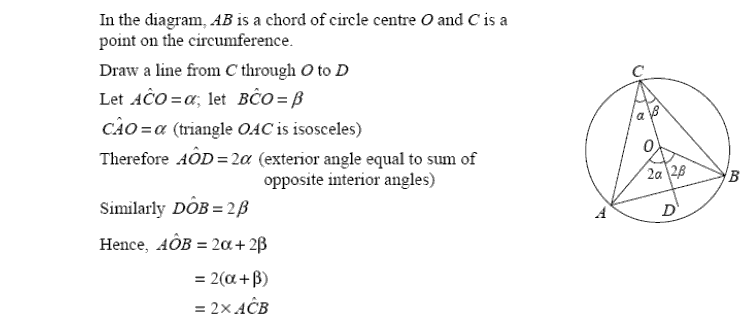
  1. Proof that the angle subtended by a chord at the centre of a circle is twice the angle subtended at the circumference in the same segment:


view more examples
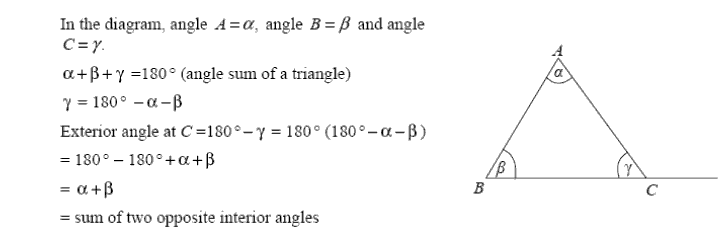
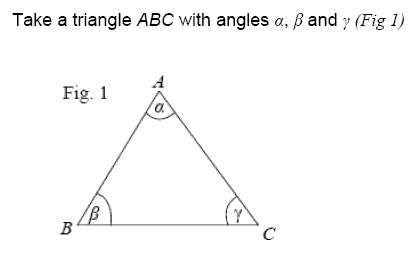
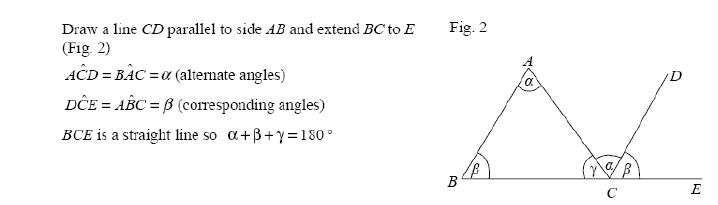
  1. Proof that the exterior angle of a triangle is equal to the sum of the two opposite interior angles:


  1. Proof that the angle subtended by a subtended by a chord at the centre of a circle is twice the angle subtended at the circumference in the same segment:

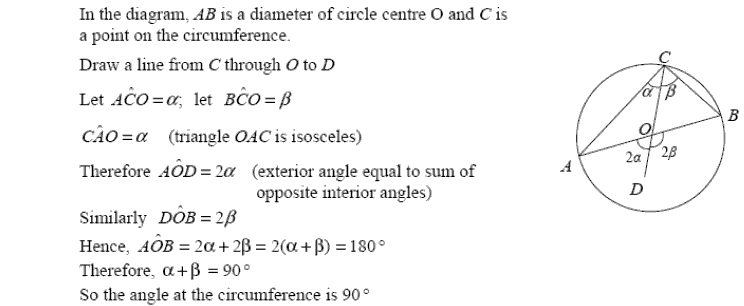
  1. Proof that the angle subtended by a diameter at the circumference is 90°:


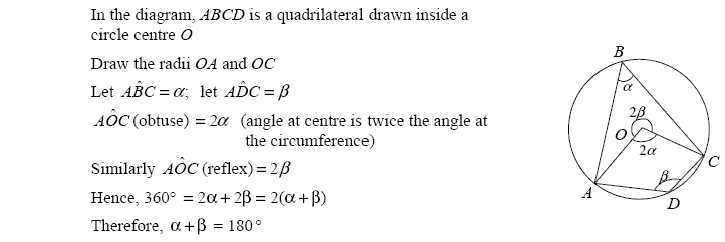
  1. Proof that the opposite angles in a cyclic triangle add to 180°:


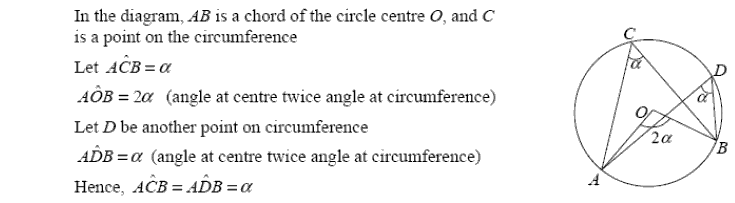
  1. Proof that the angles subtended by a chord at the circumference in the same segment are equal:


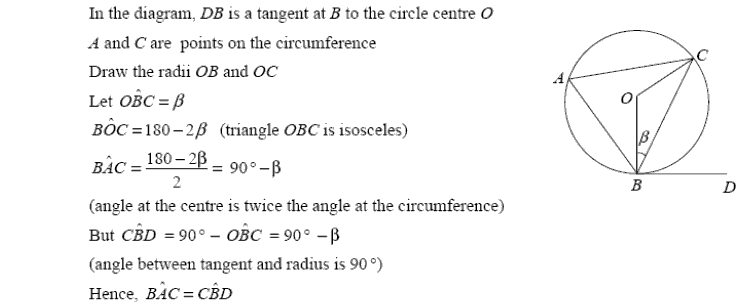
  1. Proof of the alternate segment theorem:

  1. (Example at grade A*): In questions designed to assess the highest grades, candiates would be expected to construct a proof which they may not have encountered before.

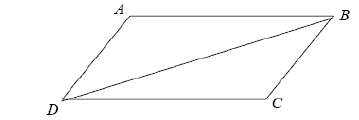
          ABCD is a parallelogram. The line BD is drawn.

          Prove that triangles ABD and BCD are congruent.

         Answer: Candidates have a choice of proofs. The following are all valid 
         starting points.

         Identify two pairs of equal angles - stating reasons (two pairs of equal alternate
         angles, or one
pair plus opposite angles of a parallelogram).

         Identify the common side.

         Give the reason for congruence (AAS).

         AB = DC (opposite sides of a parallelogram).

         AD = BC (opposite sides of a parallelogram).

         DB is a common side.

         Triangles ABD and BCD are congruent because of

         Angle ADB = Angle DBC (alternate angles)