AQA All About Maths
Print this page
view more examples
Topic: Circle Theorems; Geometrical Proof (Higher - Unit 3)
| Specification References: G1.5h G1.5h Distinguish between centre, radius, chord, diameter, circumference, tangent, arc, sector and segment. Know and use circle theorems. |
Candidates should be able to:
- understand that the tangent at any point on a circle is perpendicular to the radius at that point
- understand and use the fact that tangents from an external point are equal in length
- explain why the perpendicular from the centre to a chord bisects the chord
- understand that inscribed regular polygons can be constructed by equal division of a circle
- prove and use the fact that the angle subtended by an arc at the centre of a circle is twice the angle subtended at any point on the circumference
- prove and use the fact that the angle subtended at the circumference by a semicircle is a right angle
- prove and use the fact that angles in the same segment are equal
- prove and use the fact that opposite angles of a cyclic quadrilateral sum to 180 degrees
- prove and use the alternate segment theorem
Notes
Questions asking for the angle at the centre of a regular polygon may be set.
When asked to give reasons for angles any clear indication that the correct theorem is being referred to is acceptable. For example, angles on the same chord (are equal), angle at centre is equal to twice angle at circumferene angle on diameter is 90o, opposite angle in cyclic quadrilateral add up to 180o. Alternate segment.
Questions assessing quality of written communication will be set that require clear and logical steps to be shown, with reasons given.
Examples
- In the diagram, A is the centre of the circle.
ABC is an isosceles triangle in which AB = AC
AB cuts the circle at P and AC cuts the circle at Q.
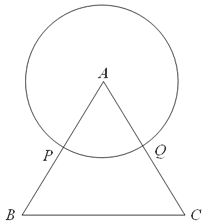
- Explain why AP = AQ
- Show that, or explain why PB = QC.
view more examples