
AQA All About Maths
Print this page
view more examples
Topic: Number, Fractions, Decimals, Percentage, Ratio and Proportion (Higher - Unit 3)
| Specification References: N3.3h N3.3h Solve problems involving ratio and proportion, including the unitary method of solution, direct and indirect proportion and exponential growth |
Candidates should be able to:
- use ratio and proportion to solve word problems using informal strategies or using the unitary method of solution
- solve best buy problems using informal strategies or using the unitary method of solution
- use direct proportion to solve geometrical problems
- use ratios to solve geometrical problems
- calculate an unknown quantity from quantities that vary in direct proportion or inverse proportion
- set up and use equations to solve word and other problems involving direct proportion or inverse proportion
- relate algebraic solutions to graphical representation of the equations
Notes
This reference includes all the requirements of N3.3 and some additional requirements for the Higher tier only.
Direct and inverse proportion questions will be restricted to the following proportionalities: ,
,  ,
,  ,
,  ,
,  , ,
, ,  ,
,  ,
,  ,
, 
The expected approach would be to set up an equation using a constant of proportionality. Find this and then use the equation to find a value of y given x, or x given y. Other methods may be used and can be given full credit.
Candidates should note that division in a given ratio is assessed in Unit 2 only.
Examples
- These two triangles are similar.
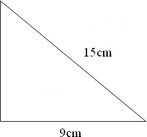
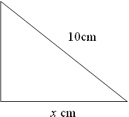
Work out the value of x.
view more examples